United Scripts: A Typeface with a Sense of Place
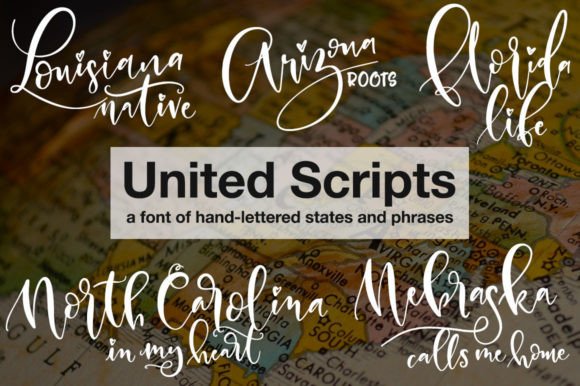
As a designer who works with brands daily, I’m always on the hunt for tools that offer more than just aesthetic appeal. I look for assets that carry a story, that bring a layer of authenticity to a project that can’t be faked. That’s why when I came across United Scripts, it immediately stood out. This isn't just another script font or a generic handwritten font; it’s a creative font with a built-in narrative. Imagine typing the letter "A" and getting a beautifully hand-lettered "Alabama." Press "C," and "Colorado" flows onto your screen. It’s a concept that turns a simple keyboard into a storytelling machine, and for anyone in branding, publishing, or content creation, that’s a powerful proposition.
More Than Just Letters: The Mechanics of a Storytelling Typeface
At its core, United Scripts is a premium font designed for display purposes. The visual style is unmistakably human. Each state name—from "Alabama" to "Wyoming"—was hand-lettered, giving it the organic, slightly imperfect charm of a true handwritten font. This isn't the sterile, uniform output of a computer; it has the warmth of ink on paper. The personality is warm, nostalgic, and distinctly American. It evokes a sense of wanderlust, home, and personal connection, making it far more than a simple script font.
What makes it so practical is its clever mapping. The 50 U.S. states are arranged alphabetically across the letter keys. This intuitive setup means you don’t have to hunt through glyph panels to find what you need. But the real ingenuity lies in the supplementary keys. The number row and punctuation marks are populated with over 25 supporting phrases. Think of lines like "CALLS ME HOME," "MY HEART IS IN," or "NATIVE." These are designed to pair perfectly with the state names, allowing you to compose a complete, heartfelt message with just a few keystrokes. For a small business owner in Tennessee, creating a logo might be as simple as typing "T" for the state and a number key for a supporting phrase. This efficiency is a game-changer for rapid prototyping and creating cohesive brand identity materials.
Where United Scripts Truly Shines
The applications for a font like this are surprisingly diverse, extending well beyond novelty projects. Its strength lies in its ability to instantly inject personality and a sense of location into a design. Here’s where I see it being most effective:
- Logo Design and Brand Identity: For businesses with a strong regional focus—a local coffee shop, a state-themed apparel brand, a travel blog, or a craft brewery—a logo built with United Scripts is instantly recognizable and full of character. It communicates a commitment to local roots without a single word of copy. It’s a fantastic way to build a brand identity that feels grounded and authentic.
- Packaging and Editorial Design: On product labels, hang tags, or book covers, this creative font can act as a powerful focal point. Imagine a "Made in Vermont" label for artisanal cheese or a chapter title in a travel memoir. It adds a tactile, personal quality that standard serif fonts or sans serif fonts can’t replicate.
- Digital and Social Media Graphics: In the fast-scrolling world of social media, a unique visual is crucial. Using United Scripts for a quote graphic or a promotional post about a specific location can stop thumbs in their tracks. Its handwritten nature feels personal and approachable, which is perfect for building community and engagement on platforms like Instagram.
- Personal and Commercial Projects: For crafters, the font is a dream. Think custom t-shirts for a family reunion, decals for a vehicle, or prints for an Etsy shop. The included PDF guide, which lists all key mappings, makes it easy to experiment and find the perfect combination. Because it comes with both OTF and TTF file types, it’s compatible with a wide range of software, from Adobe Illustrator to Cricut Design Space.
Practical Guidance for Using This Creative Font
Integrating a strong display font like United Scripts requires a bit of strategy. Its strength is also its limitation; it’s not designed for long-form body text. Here’s how to approach it for the best results:
- Evaluate Project Fit: First, consider if the font's personality aligns with your project. Its hand-lettered, all-American vibe is perfect for projects related to travel, locality, heritage, and craftsmanship. It might feel out of place in a formal corporate report or a high-tech startup's branding. Think about the story you want to tell.
- Master the Font Pairing: A script or handwritten font needs a partner. To ensure readability and create a strong visual hierarchy, pair United Scripts with a clean, simple typeface. A straightforward sans serif font like Montserrat or a classic, readable serif font like Lora works beautifully for body copy. Let United Scripts be the star for headlines, logos, or pull quotes, and let its partner handle the heavy lifting of paragraphs.
- Consider Readability: While each hand-lettered word is a work of art, legibility at very small sizes can be a concern with any handwritten font. Use it for headings and short bursts of text where its character can be fully appreciated. For web design, test it on different screen sizes to ensure the charm doesn’t turn into a squint.
- Review the Included Assets: Don’t forget the extras. The PDF guide is an essential design asset. Use it to quickly find the phrase you need instead of typing randomly. Understanding the full scope of what’s included—like the "D.C." option on the "X" key—will help you use the font to its full potential.
- Understand the Licensing: As with any commercial font, it’s vital to understand the license. United Scripts is built for commercial use, allowing you to incorporate it into client projects, products for sale, and marketing materials. This makes it a reliable design asset for professionals and entrepreneurs alike.
Ultimately, United Scripts offers something rare in modern typography: a tool that is both highly functional and deeply expressive. It’s a premium font that provides a shortcut to authentic, place-based storytelling. By understanding its personality and applying it thoughtfully, you can leverage its unique design to create memorable logos, engaging social content, and beautiful branded materials that truly resonate with an audience.