Monsante: A Modern Art Deco Typeface for Luxury Branding
In the world of design, typography is rarely just about legibility; it is about atmosphere. When you look at Monsante, you aren’t just seeing letters arranged on a grid; you are seeing a specific kind of attitude. It is a typeface that borrows heavily from the geometric precision of the 1920s Art Deco movement but filters it through a lens of contemporary minimalism. For designers, entrepreneurs, and creatives looking for a premium font that signals sophistication without feeling antiquated, Monsante offers a compelling solution. It bridges the gap between historical grandeur and modern clarity, making it a versatile asset for a wide range of visual projects.
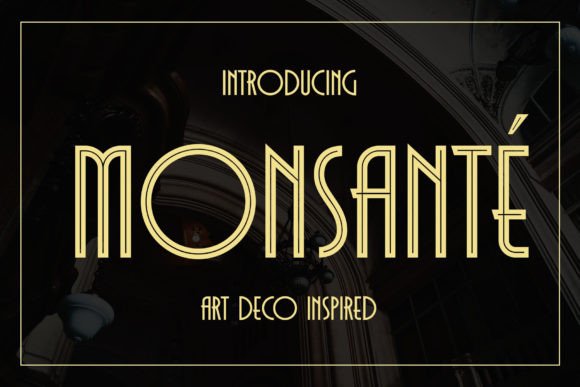
The visual DNA of Monsante is built on contrast and structure. Unlike the ornate scripts of the Victorian era, Art Deco typography is defined by symmetry, strong vertical lines, and geometric shapes. Monsante captures this essence perfectly. The letterforms are constructed with a distinct sense of balance, featuring high-contrast strokes where thick and thin lines meet sharply. This creates a crisp, architectural feel that commands attention. It isn’t a serif font in the traditional sense, nor is it a standard sans serif font. Instead, it occupies a unique space as a display font—designed specifically for impact rather than long-form reading.
The Two Faces of Elegance: Regular and Inline
One of the practical strengths of Monsante is its versatility, largely thanks to its two distinct styles: Regular and Inline. Understanding the difference between these two is key to using the typeface effectively.
The Regular style offers solid, geometric shapes. It is the workhorse of the family, providing a clean, bold appearance that works exceptionally well for headlines and logo design. The solid weight gives it a grounded, authoritative presence, making it ideal for establishing a strong visual hierarchy on a poster or a website landing page.
The Inline style, however, is where the personality truly shines. By introducing a fine line running through the center of the letterforms, the Inline version adds a layer of texture and depth. This style evokes the glamour of the Golden Age of Hollywood or the intricate etchings on a vintage award certificate. It is more decorative and stylistic, making it perfect for wedding invitations, event signage, or social media graphics where you want to add a touch of flair. When used sparingly, the Inline style can transform a standard layout into something truly memorable.
Practical Applications: Where Monsante Fits Best
Choosing the right typeface is about matching the tool to the task. Monsante excels in scenarios where you need to capture attention immediately. Because it is a display font, it is not recommended for body copy or long paragraphs. However, for specific applications, it is incredibly effective.
Branding and Identity: If you are developing a brand identity for a luxury product—think high-end cosmetics, boutique hotels, or fashion labels—Monsante sets an immediate tone of exclusivity. A logo designed with Monsante communicates that the brand values aesthetics and quality.
Publishing and Editorial: In editorial design, such as magazine covers or book jackets, this typeface serves as a powerful hook. It draws the eye to the title, establishing the mood of the content before the reader even turns the page. It pairs particularly well with clean, minimalist layouts where the typography can breathe.
Events and Stationery: For personal projects like weddings or galas, Monsante brings a sense of occasion. Its geometric elegance fits perfectly within packaging design for favors, menu headers, and table numbers. It helps create a cohesive theme that feels curated and intentional.
Enhancing Visual Hierarchy and Brand Perception
Typography influences how an audience perceives a brand on a subconscious level. The geometric nature of Monsante suggests stability, modernity, and confidence. When used in web design or social media graphics, it helps cut through the noise of crowded feeds. The high-contrast letterforms are distinct enough to remain recognizable even at smaller sizes, such as in Instagram story headers or YouTube thumbnails.
Furthermore, using a creative font like Monsante allows for better visual hierarchy. By using the Regular style for main headlines and the Inline style for sub-headers or accents, you create a natural flow for the viewer's eye. This distinction helps organize information without relying on heavy borders or excessive color changes. It is a subtle but effective way to guide your audience through your content, ensuring that your key messages are seen first.
Pairing and Technical Considerations
A great design asset rarely works in isolation. To get the most out of Monsante, you need to consider font pairing. Because Monsante is highly stylized and geometric, it pairs best with simple, neutral typefaces. A classic sans serif like Helvetica or a modern sans-serif with low contrast works well for body text, allowing Monsante to remain the star of the show for headlines. Avoid pairing it with other decorative fonts or heavy scripts, as this can create visual clutter and reduce readability.
From a technical standpoint, Monsante is designed for ease of use. It is PUA encoded, which stands for Private Use Areas. For designers, this is a significant benefit. It means that all the special characters, ligatures, and stylistic alternates are accessible even in software that does not have advanced OpenType support. You can easily copy and paste special glyphs from a character map into your design software, ensuring you have full creative control over the typography.
When evaluating if Monsante is the right fit for your project, consider the medium. It performs exceptionally well in print—on business cards, letterheads, and posters—where the crisp edges of the vector paths can be appreciated. In digital formats, ensure that you are using it for large display sizes. If you are building a website, consider loading it only for headers to maintain fast page speed, as display fonts can be heavier than standard text fonts.
Final Thoughts on Choosing Monsante
Ultimately, typography is a tool for communication. Monsante is not just a collection of letters; it is a design strategy. It is for the entrepreneur who wants to look established, the designer who wants to capture a vintage-modern aesthetic, and the crafter who wants to add a professional polish to their work. By understanding its strengths—its geometric roots, its two versatile styles, and its ease of use—you can leverage this modern typography to elevate your projects from ordinary to exceptional. Whether you are designing a logo, laying out a menu, or creating a title sequence, Monsante provides the structure and style needed to make a lasting impression.